



Otto DIYキットで1時間で自分だけのロボットを作ろう
部品と用品
| Otto DIY Builder Kit | ×1 |
| Otto DIY Arduino NANO Shield I/O | ×1 |
| Arduino Nano Every | ×1 |
| USB-A - Mini-USBケーブル | ×1 |
| SG90 マイクロサーボモーター | ×4 |
| ブザー | ×1 |
| メス-メス ジャンパーワイヤー | ×6 |
| Otto DIY 8x8mm マイクロスイッチ セルフロック オン/オフ | ×1 |
| 4xAA電池ホルダー | ×1 |
| AA電池 | ×1 |
必要なツールと機械
- 3Dプリンター(汎用)
- プラスドライバー(十字)
アプリとオンラインサービス
- Arduino IDE
- Arduino Web Editor
- Microsoft Visual Studio Code Extension for Arduino
このプロジェクトについて
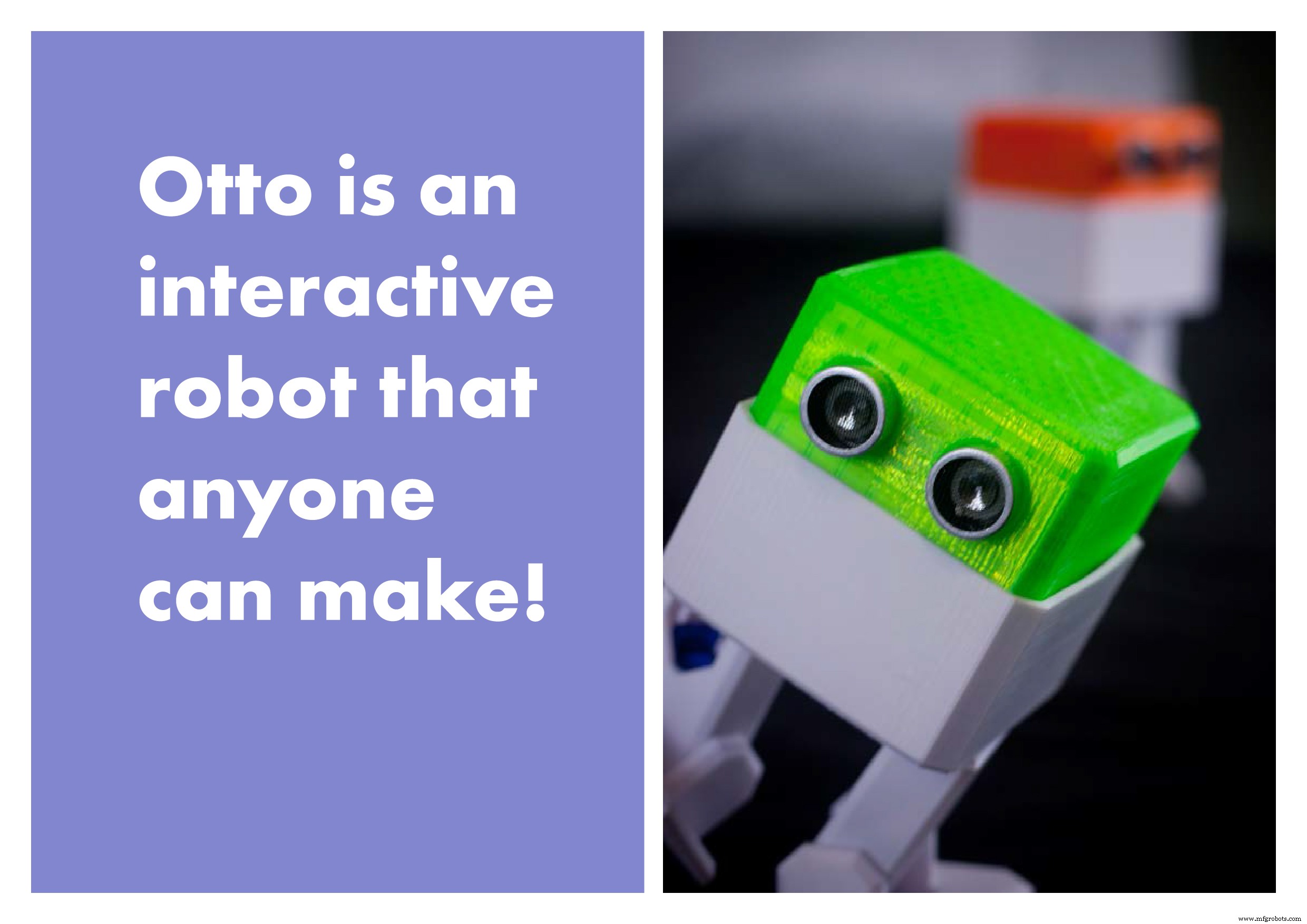
Ottoとは?
誰でも作れるインタラクティブなロボットです!
Ottoでできること
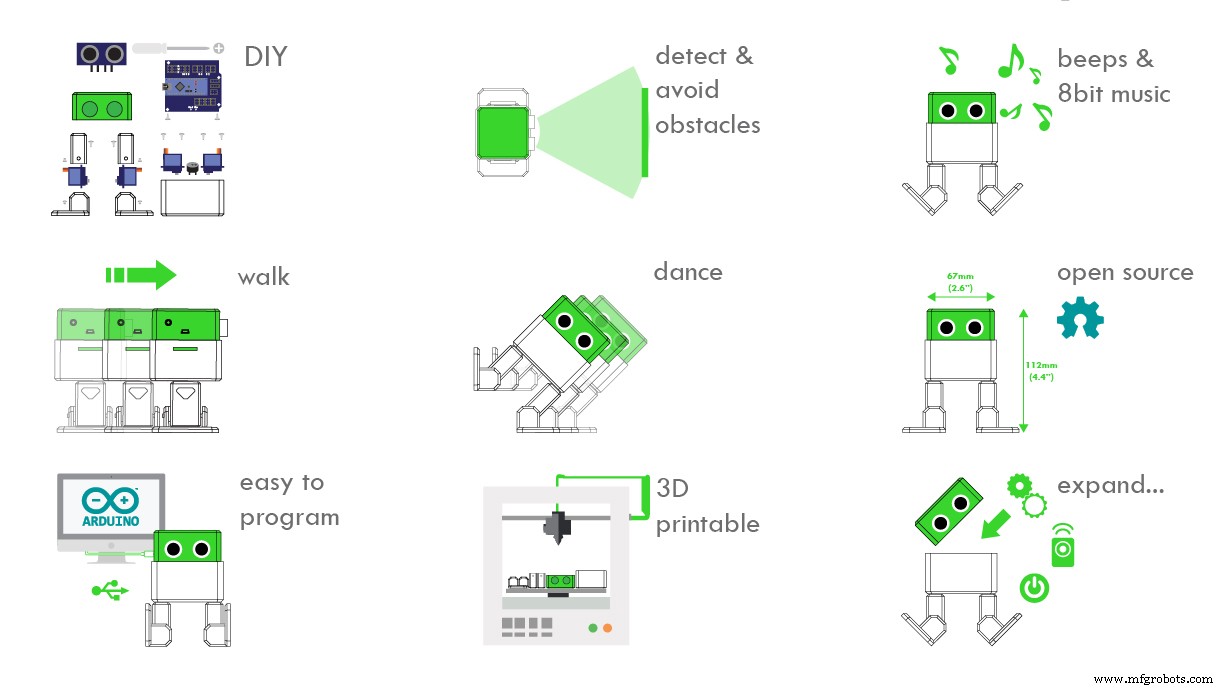
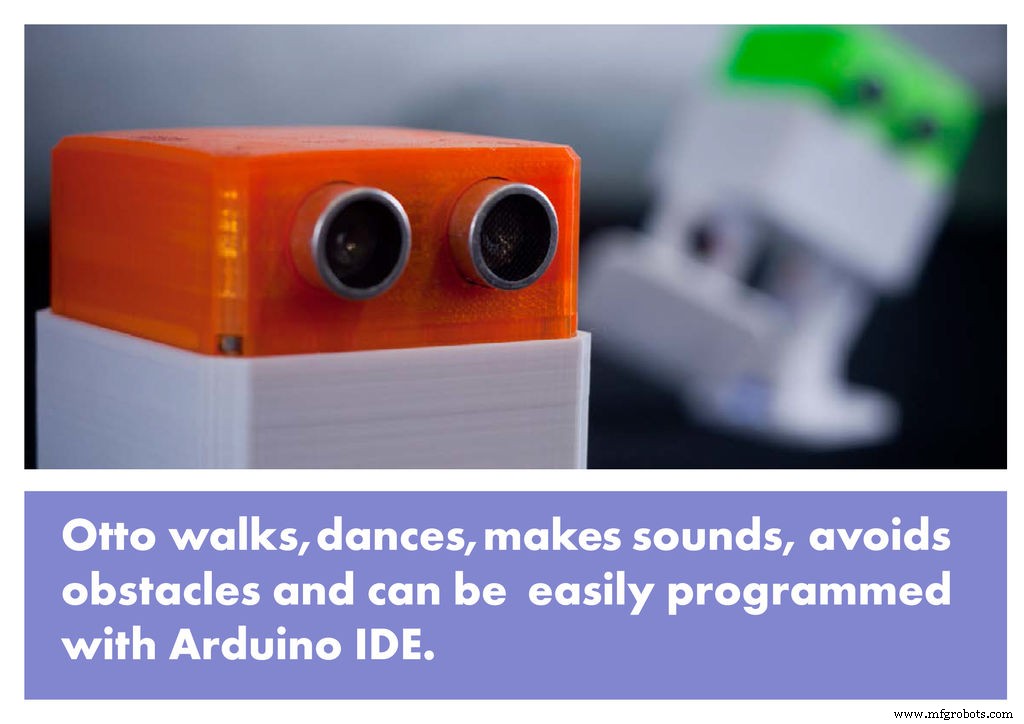
Ottoは歩き、踊り、音を出し、障害物を回避します。
なぜOttoは特別なのか?
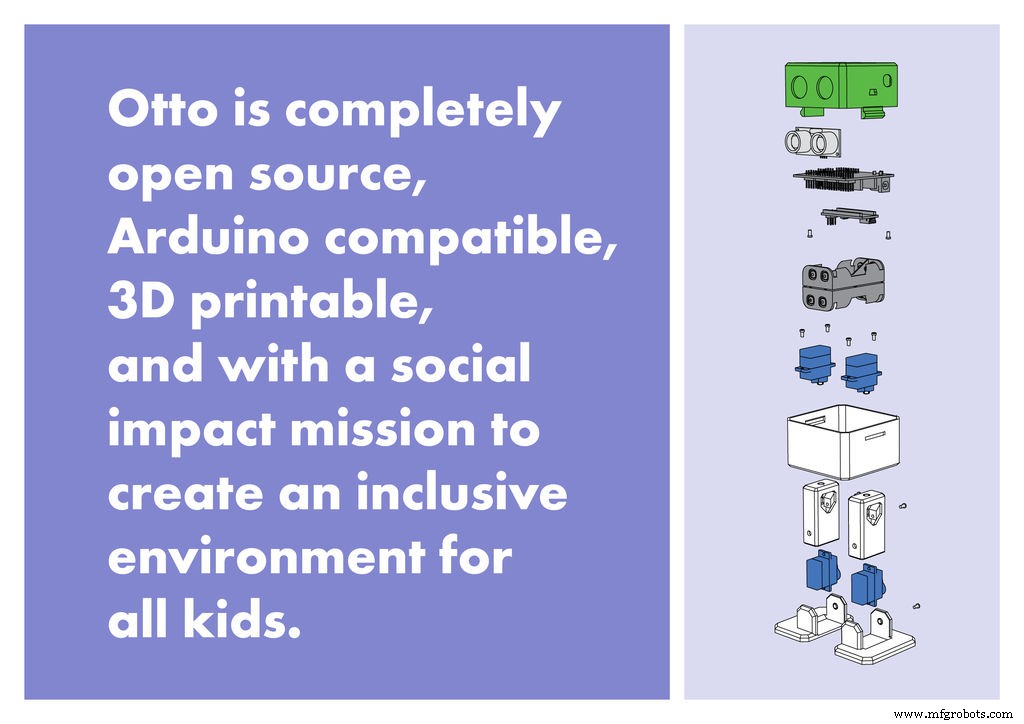
Ottoは完全にオープンソースで、Arduino互換、3Dプリント可能、そして子供たちのためのインクルーシブな環境を作るという社会的インパクトのミッションを持っています。
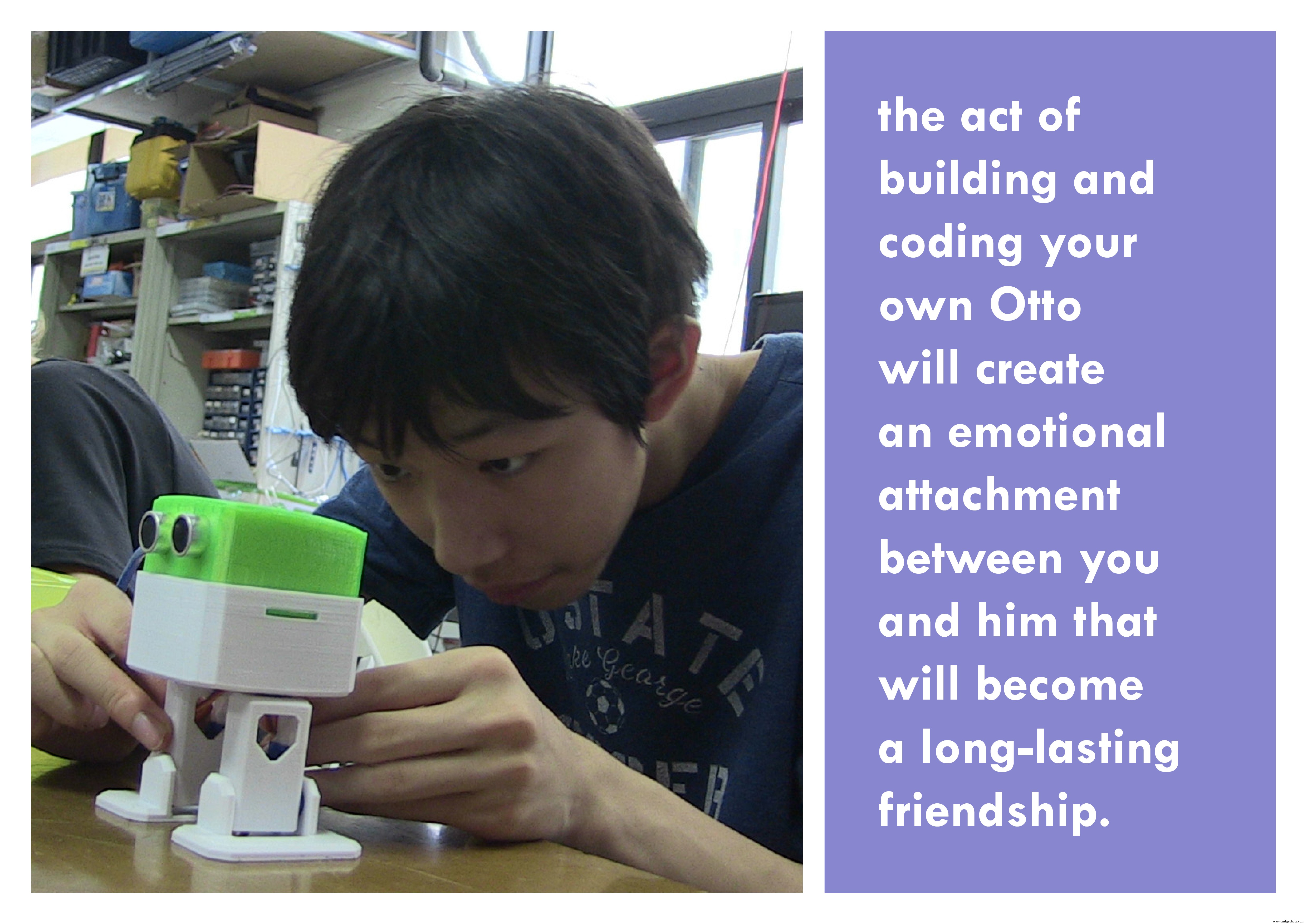
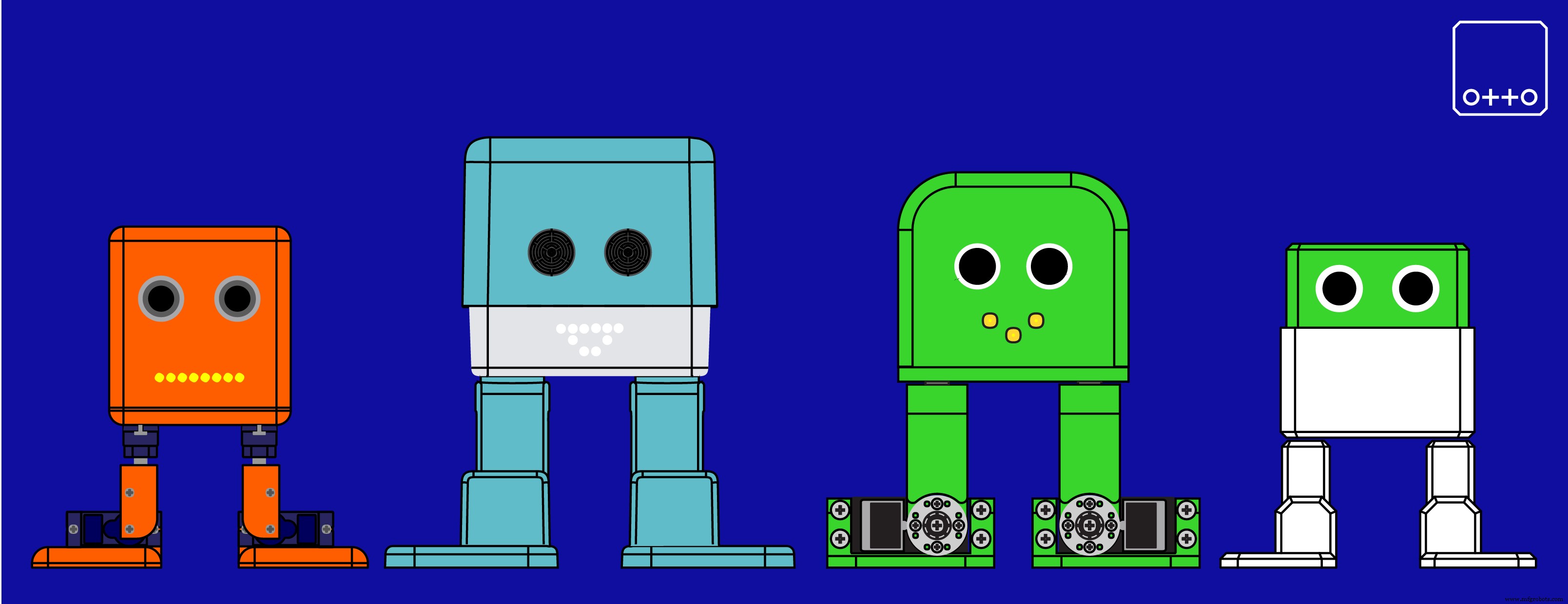
Ottoは、もう一つのロボット「BoB the BiPed」からインスピレーションを得て、オープンソースの二足歩行ロボット「Zowi」のコードを使ってプログラミングされました。
CC-BY-SA
Ottoの違いは、組み立てサイズ(11cm x 7cm x 12cm)、コンポーネントのよりクリーンな統合と表現にあります。市販部品と3Dプリント部品、シンプルな電子接続(ほぼ溶接不要)、基本的なコーディングスキルを使って、わずか1時間、あるいはそれ以下で自分だけの愛らしいOttoフレンドを作ることができます!
OttoはAutodesk 123D Design(現ThinkerCAD)で設計されており、カスタマイズや更なる改良のために修正可能です!
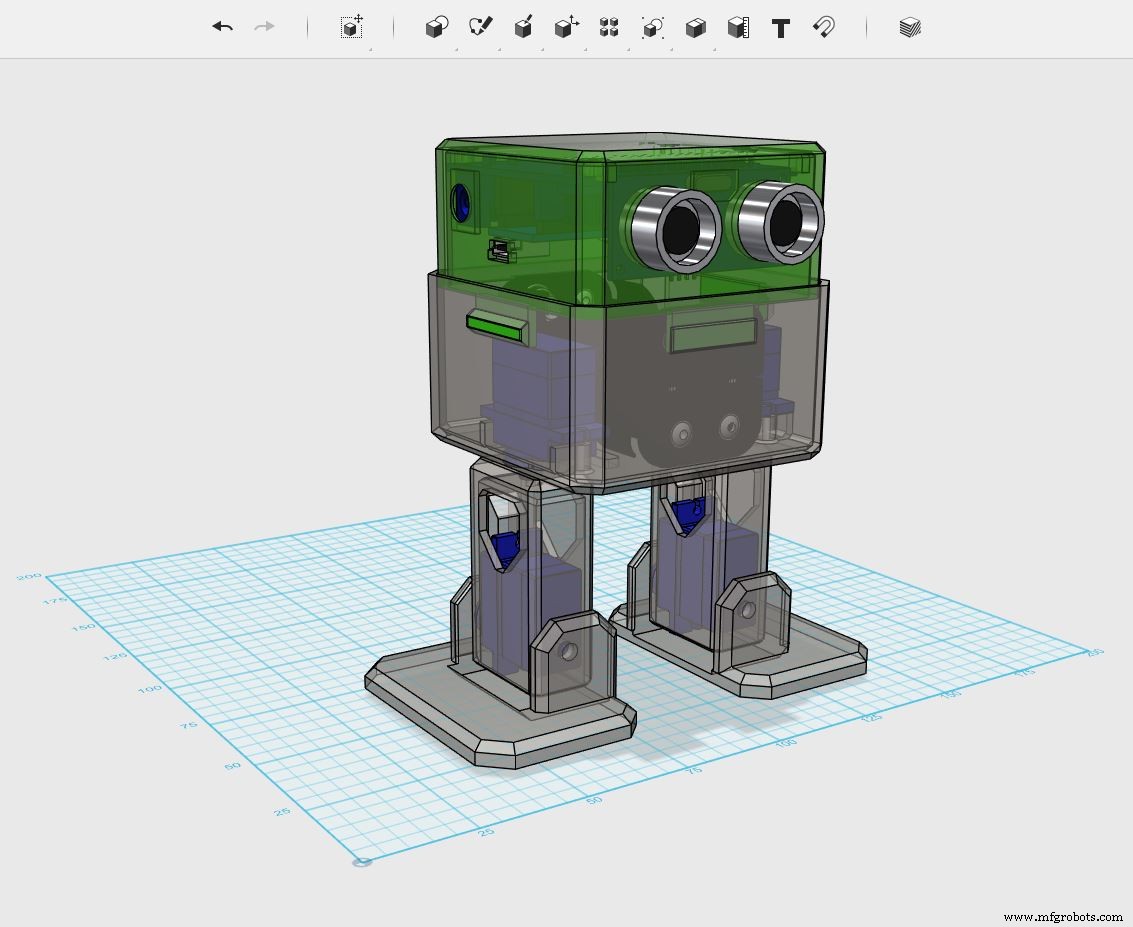
このステップバイステップガイドは、Otto DIYシンプル版の作り方に焦点を当てています。より高度な二足歩行ロボットとして、Otto DIY+やTitoもあります。
ステップ1: まず全てのパーツとツールを揃える
この組み立てに必要な市販のハードウェアパーツを全て揃えます。ミニブレッドボードはシールドの代替になりますが、より多くの配線と時間が必要です。
あとは合計6つのパーツを3Dプリントするだけです:
- 11. 3Dプリントされた頭部
- 12. 3Dプリントされた胴体
- 13. 3Dプリントされた脚 ×2
- 14. 3Dプリントされた足 ×2
オプション:3Dプリント品質が十分でなければカッターで後処理、バッテリー駆動にしたい場合はハンダゴテ(USB接続で給電も可能)
それだけです! 全ての.stlファイルをダウンロードしてください。3Dプリンターがない場合は、近くのメイカースペースを利用できます。
パーツが手に入らない、または入手が難しい場合は、フルキットを購入できます www.ottodiy.com を訪問
3Dプリント設定
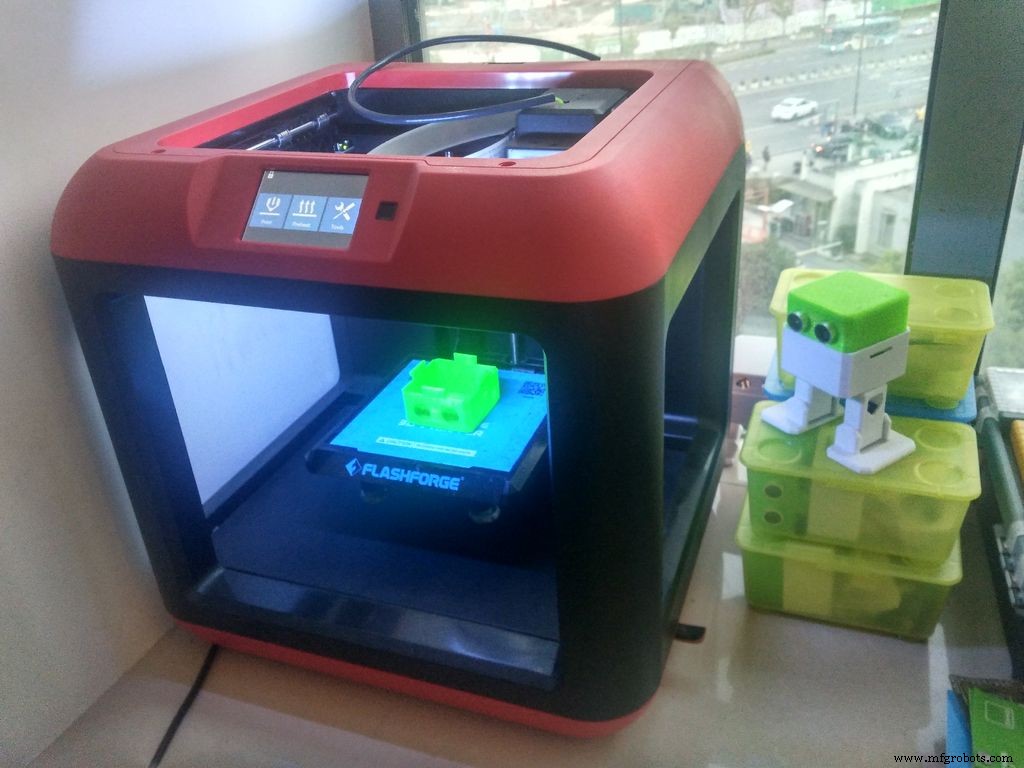
Ottoは3Dプリントに非常に適した設計です。ダウンロードしたファイルは適切に配向・中心合わせされているため、以下の一般的なパラメータに従えば問題ありません:
- PLA素材のFDM 3Dプリンターを推奨
- サポートやラフトは一切不要
- 解像度:0.15mm
- 充填密度:20%
スライシングとGコード生成には、Curaのような無料のスライサーソフトや、FlashForge Finder 3Dプリンター付属のFlashPrintを使用(外注プリントの場合は不要)
プリント後、モーターを固定する脚と足の部分を少し綺麗にする必要があります。
パーツをチェック
ステップ2で述べた通り、マイクロサーボモーターには写真の3本のネジが付属しており、読みやすいようにパーツ番号を再編成しました。ミニドライバーを磁石化しておくことを忘れずに。説明書をダウンロードまたは印刷するか、この動画に従ってください:
足部サーボの組み立て
マイクロサーボを足の中に入れ、押し込みます。硬い場合はカッターでさらに削ってください。サーボが両側に少なくとも90度回転できることを確認することが非常に重要です。動作確認後、小さなネジだけで固定します。もう片方の足も同じ手順で行います。
サーボを胴体に固定
残りの2つのマイクロサーボを3Dプリントされた胴体の指定位置に入れ、尖ったネジだけで固定します。
脚を胴体に固定
脚をマイクロサーボのハブに接続します。足のサーボと同様に、脚が胴体に対して両側90度回転できることを確認してください。アライメント確認後、脚の内側の穴に小さなネジで固定します。
足を脚に固定
図のようにケーブルに注意しながら、ケーブルを胴体のスロットに通し、脚の穴を通します。正しい位置になったら、後ろから尖ったネジで固定します。
頭部の組み立て
超音波センサーから始めます。目を限界まで引き出すことが重要です。Arduino Nanoをシールドに入れた後、オプションでバッテリーホルダーのプラスケーブルをボードのVinに、マイナスを任意のGNDにハンダ付けできます。両方の基板を斜めに挿入し、USBコネクターが3Dプリントされた頭部の穴に向くようにし、最後の2本の尖ったネジで固定します。
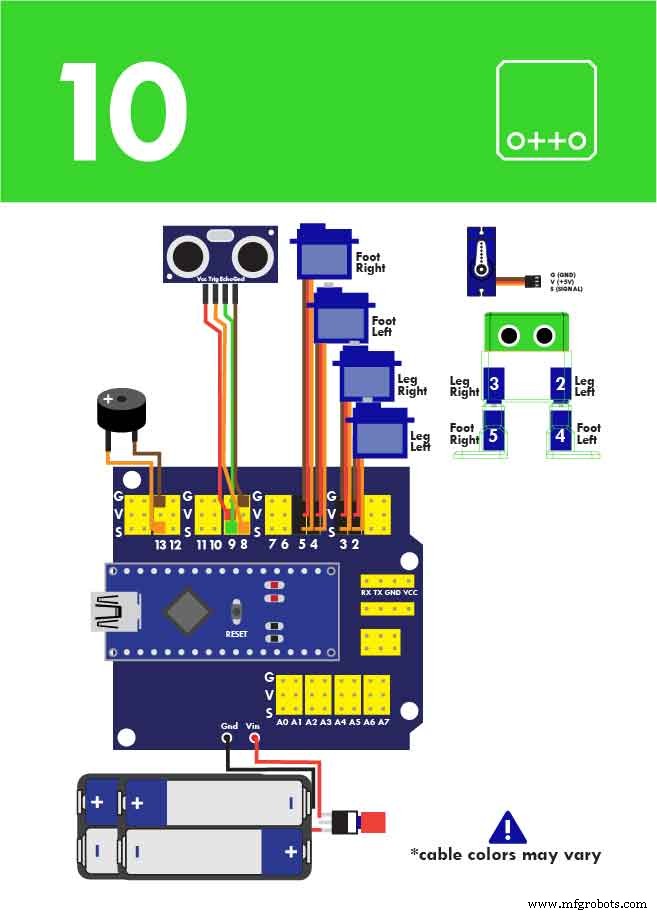
ステップ9: 電気接続
DuPontケーブル、マイクロスイッチ、ブザーを準備します。その後、ピン番号図に従って正しい位置に接続してください。Arduino Nanoシールドがない場合は、ブレッドボードとこの回路図(TinkerCAD Circuits)に従ってください。
ブロックでコーディング
Otto WikifactoryからソースArduinoコードを試すことができます。初心者がArduinoの各コンポーネントで素早く始めるための補完的なチュートリアルはこちら:
- サーボモーターチュートリアル: https://arduinogetstarted.com/tutorials/arduino-servo-motor
- 超音波センサーチュートリアル: https://arduinogetstarted.com/tutorials/arduino-ultrasonic-sensor
- タッチセンサーチュートリアル: https://arduinogetstarted.com/tutorials/arduino-touch-sensor
- ブザーチュートリアル: https://arduinogetstarted.com/tutorials/arduino-piezo-buzzer
www.ottodiy.com を訪問
Otto DIY+版は、Bluetooth、より多くのセンサー、インタラクションを使用して更なる可能性を秘めています。あなたのリミックスや改造をWikifactoryに投稿してください!
コード
障害物回避
Ottoは障害物を検知するまで無限に歩き続け、驚いて後退し、方向転換してから歩き続けます。
//---------------------------------------------------------------- //-- Zowi basic firmware v2 adapted to Otto //-- (c) BQ. Released under a GPL licencse //-- 04 December 2015 //-- Authors: Anita de Prado: ana.deprado@bq.com //-- Jose Alberca: jose.alberca@bq.com //-- Javier Isabel: javier.isabel@bq.com //-- Juan Gonzalez (obijuan): juan.gonzalez@bq.com //-- Irene Sanz : irene.sanz@bq.com //----------------------------------------------------------------- //-- Experiment with all the features that Otto has thanks to Zowi! //----------------------------------------------------------------- #include <Servo.h> #include <Oscillator.h> #include <EEPROM.h> #include <BatReader.h> #include <US.h> #include <LedMatrix.h> #include <EnableInterrupt.h> #include <OttoSerialCommand.h> OttoSerialCommand SCmd; //The SerialCommand object //-- Otto Library #include <Otto.h> Otto Otto; //This is Otto! //--------------------------------------------------------- //-- First step: Configure the pins where the servos are attached /* --------------- | O O | |---------------| YR 3==> | | <== YL 2 --------------- || || || || RR 5==> ----- ------ <== RL 4 |----- ------| */ #define PIN_YL 2 //servo[0] #define PIN_YR 3 //servo[1] #define PIN_RL 4 //servo[2] #define PIN_RR 5 //servo[3] //---Otto Buttons #define PIN_SecondButton 6 #define PIN_ThirdButton 7 /////////////////////////////////////////////////////////////////// //-- Global Variables -------------------------------------------// /////////////////////////////////////////////////////////////////// const char programID[]="Otto_todo"; //Each program will have a ID const char name_fac='$'; //Factory name const char name_fir='#'; //First name //-- Movement parameters int T=1000; //Initial duration of movement int moveId=0; //Number of movement int moveSize=15; //Asociated with the height of some movements //--------------------------------------------------------- //-- Otto has 5 modes: //-- * MODE = 0: Otto is awaiting //-- * MODE = 1: Dancing mode! //-- * MODE = 2: Obstacle detector mode //-- * MODE = 3: Noise detector mode //-- * MODE = 4: OttoPAD or any Teleoperation mode (listening SerialPort). //--------------------------------------------------------- volatile int MODE=0; //State of Otto in the principal state machine. volatile bool buttonPushed=false; //Variable to remember when a button has been pushed volatile bool buttonAPushed=false; //Variable to remember when A button has been pushed volatile bool buttonBPushed=false; //Variable to remember when B button has been pushed unsigned long previousMillis=0; int randomDance=0; int randomSteps=0; bool obstacleDetected = false; /////////////////////////////////////////////////////////////////// //-- Setup ------------------------------------------------------// /////////////////////////////////////////////////////////////////// void setup(){ //Serial communication initialization Serial.begin(115200); pinMode(PIN_SecondButton,INPUT); pinMode(PIN_ThirdButton,INPUT); //Set the servo pins Otto.init(PIN_YL,PIN_YR,PIN_RL,PIN_RR,true); //Uncomment this to set the servo trims manually and save on EEPROM //Otto.setTrims(TRIM_YL, TRIM_YR, TRIM_RL, TRIM_RR); //Otto.saveTrimsOnEEPROM(); //Uncomment this only for one upload when you finaly set the trims. //Set a random seed randomSeed(analogRead(A6)); //Interrumptions enableInterrupt(PIN_SecondButton, secondButtonPushed, RISING); enableInterrupt(PIN_ThirdButton, thirdButtonPushed, RISING); //Setup callbacks for SerialCommand commands SCmd.addCommand("S", receiveStop); // sendAck & sendFinalAck SCmd.addCommand("L", receiveLED); // sendAck & sendFinalAck SCmd.addCommand("T", recieveBuzzer); // sendAck & sendFinalAck SCmd.addCommand("M", receiveMovement); // sendAck & sendFinalAck SCmd.addCommand("H", receiveGesture); // sendAck & sendFinalAck SCmd.addCommand("K", receiveSing); // sendAck & sendFinalAck SCmd.addCommand("C", receiveTrims); // sendAck & sendFinalAck SCmd.addCommand("G", receiveServo); // sendAck & sendFinalAck SCmd.addCommand("D", requestDistance); SCmd.addCommand("N", requestNoise); SCmd.addCommand("B", requestBattery); SCmd.addCommand("I", requestProgramId); SCmd.addDefaultHandler(receiveStop); //Otto wake up! Otto.sing(S_connection); Otto.home(); delay(50); // Animation Uuuuuh - A little moment of initial surprise //----- for(int i=0; i<2; i++){ for (int i=0;i<8;i++){ if(buttonPushed){break;} Otto.putAnimationMouth(littleUuh,i); delay(150); } } //----- //Smile for a happy Otto :) if(!buttonPushed){ Otto.putMouth(smile); Otto.sing(S_happy); delay(200); } //If Otto's name is '#' means that Otto hasn't been baptized //In this case, Otto does a longer greeting //5 = EEPROM address that contains first name character if (EEPROM.read(5)==name_fir){ if(!buttonPushed){ Otto.jump(1,700); delay(200); } if(!buttonPushed){ Otto.shakeLeg(1,T,1); } if(!buttonPushed){ Otto.putMouth(smallSurprise); Otto.swing(2,800,20); Otto.home(); } } if(!buttonPushed){ Otto.putMouth(happyOpen); } previousMillis = millis(); } /////////////////////////////////////////////////////////////////// //-- Principal Loop ---------------------------------------------// /////////////////////////////////////////////////////////////////// void loop() { //-- MODE 2 - Obstacle detector mode if(obstacleDetected){ Otto.sing(S_surprise); Otto.playGesture(OttoFretful); Otto.sing(S_fart3); Otto.walk(2,1300,-1); Otto.turn(2,1000,-1); delay(50); obstacleDetector(); } else{ Otto.walk(1,1000,1); obstacleDetector(); } } /////////////////////////////////////////////////////////////////// //-- Functions --------------------------------------------------// /////////////////////////////////////////////////////////////////// //-- Function executed when second button is pushed void secondButtonPushed(){ buttonAPushed=true; if(!buttonPushed){ buttonPushed=true; Otto.putMouth(smallSurprise); } } //-- Function executed when third button is pushed void thirdButtonPushed(){ buttonBPushed=true; if(!buttonPushed){ buttonPushed=true; Otto.putMouth(smallSurprise); } } //-- Function to read distance sensor & to actualize obstacleDetected variable void obstacleDetector(){ int distance = Otto.getDistance(); if(distance<15){ obstacleDetected = true; }else{ obstacleDetected = false; } } //-- Function to receive Stop command. void receiveStop(){ sendAck(); Otto.home(); sendFinalAck(); } //-- Function to receive LED commands void receiveLED(){ //sendAck & stop if necessary sendAck(); Otto.home(); //Examples of receiveLED Bluetooth commands //L 000000001000010100100011000000000 //L 001111111111111111111111111111111 (todos los LED encendidos) unsigned long int matrix; char *arg; char *endstr; arg=SCmd.next(); //Serial.println (arg); if (arg != NULL) { matrix=strtoul(arg,&endstr,2); // Converts a char string to unsigned long integer Otto.putMouth(matrix,false); }else{ Otto.putMouth(xMouth); delay(2000); Otto.clearMouth(); } sendFinalAck(); } //-- Function to receive buzzer commands void recieveBuzzer(){ //sendAck & stop if necessary sendAck(); Otto.home(); bool error = false; int frec; int duration; char *arg; arg = SCmd.next(); if (arg != NULL) { frec=atoi(arg); } // Converts a char string to an integer else {error=true;} arg = SCmd.next(); if (arg != NULL) { duration=atoi(arg); } // Converts a char string to an integer else {error=true;} if(error==true){ Otto.putMouth(xMouth); delay(2000); Otto.clearMouth(); }else{ Otto._tone(frec, duration, 1); } sendFinalAck(); } //-- Function to receive TRims commands void receiveTrims(){ //sendAck & stop if necessary sendAck(); Otto.home(); int trim_YL,trim_YR,trim_RL,trim_RR; //Definition of Servo Bluetooth command //C trim_YL trim_YR trim_RL trim_RR //Examples of receiveTrims Bluetooth commands //C 20 0 -8 3 bool error = false; char *arg; arg=SCmd.next(); if (arg != NULL) { trim_YL=atoi(arg); } // Converts a char string to an integer else {error=true;} arg = SCmd.next(); if (arg != NULL) { trim_YR=atoi(arg); } // Converts a char string to an integer else {error=true;} arg = SCmd.next(); if (arg != NULL) { trim_RL=atoi(arg); } // Converts a char string to an integer else {error=true;} arg = SCmd.next(); if (arg != NULL) { trim_RR=atoi(arg); } // Converts a char string to an integer else {error=true;} if(error==true){ Otto.putMouth(xMouth); delay(2000); Otto.clearMouth(); }else{ //Save it on EEPROM Otto.setTrims(trim_YL, trim_YR, trim_RL, trim_RR); Otto.saveTrimsOnEEPROM(); //Uncomment this only for one upload when you finaly set the trims. } sendFinalAck(); } //-- Function to receive Servo commands void receiveServo(){ sendAck(); moveId = 30; //Definition of Servo Bluetooth command //G servo_YL servo_YR servo_RL servo_RR //Example of receiveServo Bluetooth commands //G 90 85 96 78 bool error = false; char *arg; int servo_YL,servo_YR,servo_RL,servo_RR; arg=SCmd.next(); if (arg != NULL) { servo_YL=atoi(arg); } // Converts a char string to an integer else {error=true;} arg = SCmd.next(); if (arg != NULL) { servo_YR=atoi(arg); } // Converts a char string to an integer else {error=true;} arg = SCmd.next(); if (arg != NULL) { servo_RL=atoi(arg); } // Converts a char string to an integer else {error=true;} arg = SCmd.next(); if (arg != NULL) { servo_RR=atoi(arg); } // Converts a char string to an integer else {error=true;} if(error==true){ Otto.putMouth(xMouth); delay(2000); Otto.clearMouth(); }else{ //Update Servo: int servoPos[4]={servo_YL, servo_YR, servo_RL, servo_RR}; Otto._moveServos(200, servoPos); //Move 200ms } sendFinalAck(); } //-- Function to receive movement commands void receiveMovement(){ sendAck(); if (Otto.getRestState()==true){ Otto.setRestState(false); } //Definition of Movement Bluetooth commands //M MoveID T MoveSize char *arg; arg = SCmd.next(); if (arg != NULL) {moveId=atoi(arg);} else{ Otto.putMouth(xMouth); delay(2000); Otto.clearMouth(); moveId=0; //stop } arg = SCmd.next(); if (arg != NULL) {T=atoi(arg);} else{ T=1000; } arg = SCmd.next(); if (arg != NULL) {moveSize=atoi(arg);} else{ moveSize =15; } } //-- Function to execute the right movement according the movement command received. void move(int moveId){ bool manualMode = false; switch (moveId) { case 0: Otto.home(); break; case 1: //M 1 1000 Otto.walk(1,T,1); break; case 2: //M 2 1000 Otto.walk(1,T,-1); break; case 3: //M 3 1000 Otto.turn(1,T,1); break; case 4: //M 4 1000 Otto.turn(1,T,-1); break; case 5: //M 5 1000 30 Otto.updown(1,T,moveSize); break; case 6: //M 6 1000 30 Otto.moonwalker(1,T,moveSize,1); break; case 7: //M 7 1000 30 Otto.moonwalker(1,T,moveSize,-1); break; case 8: //M 8 1000 30 Otto.swing(1,T,moveSize); break; case 9: //M 9 1000 30 Otto.crusaito(1,T,moveSize,1); break; case 10: //M 10 1000 30 Otto.crusaito(1,T,moveSize,-1); break; case 11: //M 11 1000 Otto.jump(1,T); break; case 12: //M 12 1000 30 Otto.flapping(1,T,moveSize,1); break; case 13: //M 13 1000 30 Otto.flapping(1,T,moveSize,-1); break; case 14: //M 14 1000 20 Otto.tiptoeSwing(1,T,moveSize); break; case 15: //M 15 500 Otto.bend(1,T,1); break; case 16: //M 16 500 Otto.bend(1,T,-1); break; case 17: //M 17 500 Otto.shakeLeg(1,T,1); break; case 18: //M 18 500 Otto.shakeLeg(1,T,-1); break; case 19: //M 19 500 20 Otto.jitter(1,T,moveSize); break; case 20: //M 20 500 15 Otto.ascendingTurn(1,T,moveSize); break; default: manualMode = true; break; } if(!manualMode){ sendFinalAck(); } } //-- Function to receive gesture commands void receiveGesture(){ //sendAck & stop if necessary sendAck(); Otto.home(); //Definition of Gesture Bluetooth commands //H GestureID int gesture = 0; char *arg; arg = SCmd.next(); if (arg != NULL) {gesture=atoi(arg);} else { Otto.putMouth(xMouth); delay(2000); Otto.clearMouth(); } switch (gesture) { case 1: //H 1 Otto.playGesture(OttoHappy); break; case 2: //H 2 Otto.playGesture(OttoSuperHappy); break; case 3: //H 3 Otto.playGesture(OttoSad); break; case 4: //H 4 Otto.playGesture(OttoSleeping); break; case 5: //H 5 Otto.playGesture(OttoFart); break; case 6: //H 6 Otto.playGesture(OttoConfused); break; case 7: //H 7 Otto.playGesture(OttoLove); break; case 8: //H 8 Otto.playGesture(OttoAngry); break; case 9: //H 9 Otto.playGesture(OttoFretful); break; case 10: //H 10 Otto.playGesture(OttoMagic); break; case 11: //H 11 Otto.playGesture(OttoWave); break; case 12: //H 12 Otto.playGesture(OttoVictory); break; case 13: //H 13 Otto.playGesture(OttoFail); break; default: break; } sendFinalAck(); } //-- Function to receive sing commands void receiveSing(){ //sendAck & stop if necessary sendAck(); Otto.home(); //Definition of Sing Bluetooth commands //K SingID int sing = 0; char *arg; arg = SCmd.next(); if (arg != NULL) {sing=atoi(arg);} else { Otto.putMouth(xMouth); delay(2000); Otto.clearMouth(); } switch (sing) { case 1: //K 1 Otto.sing(S_connection); break; case 2: //K 2 Otto.sing(S_disconnection); break; case 3: //K 3 Otto.sing(S_surprise); break; case 4: //K 4 Otto.sing(S_OhOoh); break; case 5: //K 5 Otto.sing(S_OhOoh2); break; case 6: //K 6 Otto.sing(S_cuddly); break; case 7: //K 7 Otto.sing(S_sleeping); break; case 8: //K 8 Otto.sing(S_happy); break; case 9: //K 9 Otto.sing(S_superHappy); break; case 10: //K 10 Otto.sing(S_happy_short); break; case 11: //K 11 Otto.sing(S_sad); break; case 12: //K 12 Otto.sing(S_confused); break; case 13: //K 13 Otto.sing(S_fart1); break; case 14: //K 14 Otto.sing(S_fart2); break; case 15: //K 15 Otto.sing(S_fart3); break; case 16: //K 16 Otto.sing(S_mode1); break; case 17: //K 17 Otto.sing(S_mode2); break; case 18: //K 18 Otto.sing(S_mode3); break; case 19: //K 19 Otto.sing(S_buttonPushed); break; default: break; } sendFinalAck(); } //-- Function to send ultrasonic sensor measure (distance in "cm") void requestDistance(){ Otto.home(); //stop if necessary int distance = Otto.getDistance(); Serial.print(F("&&")); Serial.print(F("D ")); Serial.print(distance); Serial.println(F("%%")); Serial.flush(); } //-- Function to send noise sensor measure void requestNoise(){ Otto.home(); //stop if necessary int microphone= Otto.getNoise(); //analogRead(PIN_NoiseSensor); Serial.print(F("&&")); Serial.print(F("N ")); Serial.print(microphone); Serial.println(F("%%")); Serial.flush(); } //-- Function to send battery voltage percent void requestBattery(){ Otto.home(); //stop if necessary //The first read of the batery is often a wrong reading, so we will discard this value. double batteryLevel = Otto.getBatteryLevel(); Serial.print(F("&&")); Serial.print(F("B ")); Serial.print(batteryLevel); Serial.println(F("%%")); Serial.flush(); } //-- Function to send program ID void requestProgramId(){ Otto.home(); //stop if necessary Serial.print(F("&&")); Serial.print(F("I ")); Serial.print(programID); Serial.println(F("%%")); Serial.flush(); } //-- Function to send Ack comand (A) void sendAck(){ delay(30); Serial.print(F("&&")); Serial.print(F("A")); Serial.println(F("%%")); Serial.flush(); } //-- Function to send final Ack comand (F) void sendFinalAck(){ delay(30); Serial.print(F("&&")); Serial.print(F("F")); Serial.println(F("%%")); Serial.flush(); } //-- Functions with animatics //-------------------------------------------------------- void OttoLowBatteryAlarm(){ double batteryLevel = Otto.getBatteryLevel(); if(batteryLevel<45){ while(!buttonPushed){ Otto.putMouth(thunder); Otto.bendTones (880, 2000, 1.04, 8, 3); //A5 = 880 delay(30); Otto.bendTones (2000, 880, 1.02, 8, 3); //A5 = 880 Otto.clearMouth(); delay(500); } } } void OttoSleeping_withInterrupts(){ int bedPos_0[4]={100, 80, 60, 120}; if(!buttonPushed){ Otto._moveServos(700, bedPos_0); } for(int i=0; i<4;i++){ if(buttonPushed){break;} Otto.putAnimationMouth(dreamMouth,0); Otto.bendTones (100, 200, 1.04, 10, 10); if(buttonPushed){break;} Otto.putAnimationMouth(dreamMouth,1); Otto.bendTones (200, 300, 1.04, 10, 10); if(buttonPushed){break;} Otto.putAnimationMouth(dreamMouth,2); Otto.bendTones (300, 500, 1.04, 10, 10); delay(500); if(buttonPushed){break;} Otto.putAnimationMouth(dreamMouth,1); Otto.bendTones (400, 250, 1.04, 10, 1); if(buttonPushed){break;} Otto.putAnimationMouth(dreamMouth,0); Otto.bendTones (250, 100, 1.04, 10, 1); delay(500); } if(!buttonPushed){ Otto.putMouth(lineMouth); Otto.sing(S_cuddly); } Otto.home(); if(!buttonPushed){Otto.putMouth(happyOpen);} }
Arduinoソース
まずこれらのライブラリをインストール: https://github.com/OttoDIY/DIY
カスタムパーツとエンクロージャ
Thingiverse .STL 3Dプリント可能ファイル
Ottoの構築プロセスで使用する3Dプリントパーツ。Thingiverse.comのCADファイル
回路図
サーボ、超音波センサー、ブザー、バッテリーの接続。ケーブルに従ってください。DuPontケーブルを使用。
製造プロセス
- DIYサーモカム:教室アイデアからグローバル製品へ
- LEGO Mindstorms EV3用カスタムオブジェクトセンサー構築: DIY光ベース「目」
- Raspberry Pi用DIY Google Voice HATの自作ガイド
- Arduino & Raspberry Pi でインターネット制御ビデオストリーミングロボットを構築
- UAV 用弾道パラシュート回収システムの設計
- サウロン製作記:Arduino Mega 2560 製セミヒューマノイドロボット完全ガイド
- MeArmロボットアーム V1.0 – Arduino/Raspberry Piで作るロボットアーム
- 堅牢なIoTプロトタイプ構築の実証済みステップ
- DIY愛好家にエアコンプレッサーが必要な理由:メリットと選び方ガイド
- 強化学習:インテリジェント産業用ロボティクスの未来
- ロボットアーム自作のリスクとメリット:メーカーとの協業が賢明な理由